






|
- JAZZ TIMELINE -
| Jazz Timeline* |
|
1890 |
1920 |
1930 |
1945 |
1949 |
1950 |
1953 |
1960 |
1969 |
1980 |
|
Ragtime |
Early Jazz |
Swing |
Bebop |
Cool Jazz |
Latin Jazz |
Hard Bop |
Free Jazz/Freeform |
Fusion |
Contemporary |
| Notable Soloists |
Scott Joplin
Jelly Roll Morton |
James P. Johnson
Earl Hines |
Art Tatum
Teddy Wilson |
Charlie Parker (alto)
Dizzy Gillespie (trpt)
Thelonious Monk
Bud Powell
Al Haig |
Cool Jazz soloists |
Latin Jazz soloists |
Hard Bop soloists |
Free Jazz/Freeform soloists |
Fusion soloists |
Contemporary soloists |
| Notable Groups |
----- |
Early Jazz groups |
Swing groups |
Bebop groups |
Cool Jazz groups |
Latin Jazz groups |
Hard Bop |
Free Jazz/Freeform groups |
Fusion groups |
Contemporary groups |
| Quick Notes |
- a musical style noted for its syncopated or "ragged" rhythm
- closely related to marches. Ragtime pieces (often called "rags") usually contain several distinct themes, often arranged in patterns of repeats and reprises
- The music was initially distributed primarily through sheet music and piano rolls
- developed long before it was printed as sheet music |
Early Jazz notes |
Swing notes |
Bebop notes |
Cool Jazz notes |
Latin Jazz notes |
Hard Bop |
Free Jazz/Freeform notes |
Fusion notes |
Contemporary notes |
| RAGTIME |
| Timespan: 1890-1910 |
Characteristics:
Ragtime, also spelled rag-time or rag time, is a musical style noted for its syncopated or "ragged" rhythm. It originated in African American communities in the late 19th century and was propelled to popularity in the 1890s to 1910s by composers such as James Scott, Joseph Lamb, and particularly Scott Joplin. Known as the "King of Ragtime", Joplin gained fame through compositions like "Maple Leaf Rag" and "The Entertainer".
The style is closely related to marches. Ragtime pieces (often called "rags") usually contain several distinct themes, often arranged in patterns of repeats and reprises. They are typically composed for and performed on the piano, though the genre has been adapted for a variety of instruments and styles. The music was initially distributed primarily through sheet music and piano rolls.
Ragtime influenced early jazz, Harlem stride piano, Piedmont blues, and early-20th-century European classical composers such as Erik Satie, Claude Debussy, and Igor Stravinsky. It was overshadowed by jazz in the 1920s, but has since experienced several revivals, notably in the 1970s, when several of Joplin's songs were adapted for the caper film "The Sting."
|
Ragtime pioneers:
Mike Bernard (1875-1936)
George Botsford (1874-1949)
Louis Chauvin (1881-1908)
Ben Harney (1872-1938)
Tony Jackson (1882-1921) |
Scott Joplin (1868-1917)
Jelly Roll Morton (1890-1941)
Tom Turpin (1871-1932)
Percy Wenrich (1887-1952) |
|
Later ragtimers:
Eubie Blake (1887-1983)
Les C. Copeland (1887-1942)
Ford Dabney (1883-1958)
Luckey Roberts (1887-1968) |
J. Russel Robinson (1892-1963)
Willie "The Lion" Smith (1893-1973)
Fats Waller (1904-1943)
Pete Wendling (1888-1974) |
|
|
| More: |
Stride
Stride jazz piano, often shortened to stride, is a jazz piano style that arose from ragtime players. Prominent stride pianists include James P. Johnson, Willie "the Lion" Smith, Fats Waller, Luckey Roberts, and Mary Lou Williams.
Stride employed left hand techniques from ragtime, wider use of the piano's range, and quick tempos. Compositions were written but were also intended to be improvised.
The term "stride" comes from the idea of the pianist's left hand leaping, or "striding", across the piano. The left hand characteristically plays a four-beat pulse with a single bass note (or an octave, major seventh, minor seventh or major tenth interval) on the first and third beats, and a chord on the second and fourth beats. Occasionally this pattern is reversed by placing the chord on the downbeat and bass notes on the upbeat. Compared to the ragtime style popularized by Scott Joplin, stride players' left hands travel greater distances on the keyboard.
Stride piano is highly rhythmic because of the alternating bass note and chord action of the left hand while the right hand plays syncopated melody lines with harmonic and riff embellishments and fill patterns. Proper playing of stride jazz involves a subtle rhythmic tension between the left hand which is close to the established tempo, and the right hand, which is often slightly anticipatory.
Unlike ragtime pianists, stride pianists were not concerned with ragtime form and played pop songs of the day in the stride style. Ragtime was composed, but many stride pianists improvised. Some stride players didn't read music. Stride used tension and release and dynamics. Stride can be played at all tempos, slow or fast depending on the underlying composition and treatment the pianist is performing. On occasion a stride jazz pianist might have the left hand shift into double time.
James P. Johnson (1894-1955), known as the "Father of Stride", created this style of jazz piano along with fellow pianists Willie "The Lion" Smith (1893-1973), Thomas "Fats" Waller (1904-1943) and Luckey Roberts (1887-1968). One of Johnson's contributions was to recast the "straight" feeling of ragtime with a more modern, swinging beat, sophisticated harmonies and dynamics. He discovered and employed the tenth or "broken tenth" interval. The pianist could not only substitute tenths for single bass notes but could also play broken (staggered) tenths up and down the keyboard.
Stride pianist Art Tatum (1909-1956) (a fan of Fats Waller and Lee Sims, who was himself a fan of the European "Impressionist" pianists such as Claude Debussy and Erik Satie, and hosted a radio program Tatum enjoyed) introduced more complex harmonies into his playing, and, like Fats Waller, would start songs with legato explorations of chordal intricacies before launching into swing. Tatum was given a posthumous Grammy Award in 1974.
Stride pianists used devices such as arpeggios, black note slide-offs, varying rhythmic accents, and tension and release.
Stride pianists engaged in marathon cutting contests to show off their skills.
|
| More info: Ragtime Stride |
| EARLY JAZZ |
| Timespan: 1920s |
Characteristics:
1) Much of each performance was improvised
2) Rhythmic feeling was looser and more relaxed, thus anticipating what is called jazz swing feeling
3) It generated much of its own repertory of compositions
4) The collective improvisation created a far more complex musical product than was typical in ragtime, blues, or marching band music
|
| YEAR | NOTES |
| YEAR | NOTES |
| YEAR | NOTES |
| SWING |
| Timespan: Early 1930's to the late 1940's |
Characteristics:
1) xxx
2) xxx
3) xxx
4) xxx
| | General Notes: Swing Band era |
| YEAR | NOTES |
| YEAR | NOTES |
| YEAR | NOTES |
| BEBOP |
| Timespan: Mid to late 1940's to the mid to late 1950's |
Characteristics:
1) xxx
2) xxx
3) xxx
4) xxx
| | YEAR | NOTES |
| YEAR | NOTES |
| YEAR | NOTES |
| COOL JAZZ |
| Timespan: |
Characteristics:
1) xxx
2) xxx
3) xxx
4) xxx
| | YEAR | NOTES |
| YEAR | NOTES |
| YEAR | NOTES |
| Latin Jazz |
| Timespan: |
Characteristics:
1) xxx
2) xxx
3) xxx
4) xxx
| | YEAR | NOTES |
| YEAR | NOTES |
| YEAR | NOTES |
| Hard Bop |
Timespan:
Hard bop is a subgenre of jazz that originated in the mid-1950s, emerging as a reaction to the rise of cool jazz and West Coast jazz. It developed from bebop but incorporated influences from rhythm and blues, gospel, and blues, giving it a more soulful, bluesy, and danceable character.
Timeline and Key Milestones
Mid-1950s: The term "hard bop" began to be used by journalists and record companies to describe this new jazz current.
1953-1954: Early examples include Clifford Brown's De-Dah (1953) and Thelonious Monk Quartet's Blue Monk (1954).
1954-1955: The Jazz Messengers, led by Art Blakey and Horace Silver, became central to hard bop's development, with albums like A Night at Birdland (1954) and At the Café Bohemia (1956).
1955-1957: Miles Davis's Walkin' (1954) and Miles Davis Quintet (1955) with John Coltrane helped popularize the style.
1958: Art Blakey and the Jazz Messengers released Moanin', a defining hard bop recording.
Context
Hard bop arose partly in response to bebop's perceived lack of danceability and cool jazz's European influences. It was also tied to the Civil Rights Movement, as African American musicians sought to reaffirm jazz as a form of Black cultural expression.
In short: Hard bop was firmly in jazz from the mid-1950s onward, with its most influential years spanning roughly 1954 to the late 1960s, before giving way to fusion in the late 1960s. |
Characteristics:
1) xxx
2) xxx
3) xxx
4) xxx
| | YEAR | NOTES |
| YEAR | NOTES |
| YEAR | NOTES |
| Free Jazz/Freeform |
| Timespan: |
Characteristics:
1) xxx
2) xxx
3) xxx
4) xxx
| | YEAR | NOTES |
| YEAR | NOTES |
| YEAR | NOTES |
| Fusion |
| Timespan: |
Characteristics:
1) xxx
2) xxx
3) xxx
4) xxx
| | YEAR | NOTES |
| YEAR | NOTES |
| YEAR | NOTES |
| Contemporary |
| Timespan: |
Characteristics:
1) xxx
2) xxx
3) xxx
4) xxx
| | YEAR | NOTES |
| YEAR | NOTES |
| YEAR | NOTES |
| Big Bands in the 1960s and 70s |
| 1960s and 1970s | Stan Kenton
1960s
The Kenton orchestra had been on a slow decline in sales and popularity in the late 1950s with having to compete with newer, popular music artists such as Elvis Presley, Bobby Darin, and The Platters. The nadir of this decline was around 1958 and coincided with a recession that was affecting the entire country. There were far fewer big bands on the road and live music venues were hard to book for the Kenton orchestra. The band would end 1959 beaten up by poor attendance at concerts and having to rely far more on dance halls than real jazz concerts. The band would reform in 1960 with a new look, a new sound, a larger group with a 'mellophonium' section added and an upsurge in Kenton's popularity.
The Mellophonium was a featured instrument by Stan Kenton from 1960 through the end of 1963. Though intonation was problematic, it added a unique color to the sound palate of the orchestra.
The new instrument was used by Kenton to "bridge the gap" in range, color, and tonality between his trumpet and trombone sections. Essentially it creates a conical, midrange sound that is common in a symphonic setting with a horn (French horn) but the bell of the instrument faces forward. Kenton's 1961 recording The Romantic Approach for Capitol is the first of 11 LPs that would feature the "mellophonium band". Kenton arranged the whole first mellophonium album himself and it was very well received in a September 1961 review in Down Beat.
I loved playing Johnny's music, and so did Stan. West Side Story was probably the toughest album I ever recorded...
- Jerry McKenzie
The Kenton Orchestra from 1960 to 1963 had numerous successes; the band had a relentless recording schedule. The albums Kenton's West Side Story (arrangements by Johnny Richards) and Adventures In Jazz, each won Grammy awards in 1962 and 1963 respectively. Ralph Carmichael wrote a superb set of Christmas charts for Kenton which translated into one of the most popular recordings from the band leader to date: A Merry Christmas!. Also, Johnny Richards' Adventures in Time suite (recorded in 1962) was the culmination of all things the mellophonium band was capable of. After the Fall 1963 U.S./U.K. tour ended in November, the mellophonium incarnation of Kenton bands was done. The conditions of Stan's divorce from jazz singer Ann Richards was that a judge ordered Stan to take a year off the road to help raise their two children or lose custody altogether. Kenton would not reform another road band for tour until 1965.
Kenton had ties from earlier writing of country/western songs that were a success with Capitol and again he tried his hand in that genre during the early 1960s. In a music market that was becoming increasingly tight, in 1962 he cut the hit single "Mama Sang a Song"; his last Top-40 (No. 32 Billboard, No. 22 Music Vendor). The song was a narration written by country singer Bill Anderson and spoken by Kenton. The single also received a Grammy nomination the following year in the Best Documentary or Spoken Word Recording category. The other attempt he made into that market was the far less successful Stan Kenton! Tex Ritter!, released in 1962 as a full LP.
After the breakup of the mellophonium band, Kenton / Wagner (1964) was an important recording project that Kenton himself arranged, again moving towards "progressive jazz" or third stream music. This album was not a financial success but kept Kenton at the forefront of 'art music' interpretation in the commercial music world. Stan Kenton Conducts the Los Angeles Neophonic Orchestra (1965) was an artistic success that garnered another Grammy nomination for the band leader. During this time Kenton also co-wrote the theme music for the short lived NBC television series Mister Roberts (1965-66).
The 1966-1969 Capitol releases for Stan Kenton were a severe low point for his recording career. Capitol producer Lee Gillette was trying to exploit the money making possibilities of numerous popular hits to include the 1968 musical Hair featuring contemporary rock music. Due to lack of promotion by Capitol, four LPs were financial failures; this would be the last releases for Kenton under the aegis of long time Kenton producer Lee Gillette and Capitol. In fact, by the time it was recorded Kenton had no involvement in the Hair LP except for Kenton's name placed on the jacket cover; Ralph Carmichael and Lennie Niehaus were placed in charge of the project. Two exceptions to this late 1960s period are the Billboard charted single the band cut of the Dragnet theme (1967) and another Kenton presents release featuring the music of composer and ex-bandsman Dee Barton: The Jazz Compositions of Dee Barton (1967). The album featuring Barton's music was another unsung artistic success for the Kenton band though widely unseen commercially by the a music listening public.
1970s
The transition from Capitol to Creative World Records in 1970 was fraught with difficulties during a time when the music business was changing rapidly. As a viable jazz artist who was trying to keep a loyal but dwindling following, Kenton turned to arrangers such as Hank Levy and Bob Curnow to write material that appealed to a younger audience. The first releases for the Creative World label were live concerts and Kenton had the control he wanted over content but lacked substantial resources to engineer, mix, and promote what Capitol underwrote in the past. Kenton would take a big gamble to bypass the current record industry and rely far more on the direct mail lists of jazz fans which the newly formed Creative World label would need to sell records. Kenton also made his print music available to college and high-school stage bands with several publishers. Kenton continued leading and touring with his big band up to his final performance on August 20, 1978, when he disbanded the group due to his failing health.
In June 1973 Bob Curnow had started as the new artists and repertoire manager overseeing the whole operation of the Creative World Records. It was just the year before (in 1972) the Kenton orchestra recorded the National Anthems of the World double LP with 40 arrangements all done by Curnow. As per Curnow himself:
"That was a remarkable and very difficult time for me. I was managing (Stan's) record company with NO experience in business, writing music like mad, living in a new place and culture (Los Angeles was another world), traveling a LOT (out with the band at least 1 week a month) and trying to keep it together at home."
- Bob Curnow (2013)
When Kenton took to the road during the early 1970s (one in London in 1972) and up to his last tour, he took with him seasoned veteran musicians (John Worster, Willie Maiden, Warren Gale, Graham Ellis, and others) teaming them with relatively unknown young artists, and new arrangements (including those by Hank Levy, Bill Holman, Bob Curnow, Willie Maiden, and Ken Hanna) were used. Many alumni associated with Kenton from this era became educators (Mike Vax, John Von Ohlen, Chuck Carter, Lisa Hittle, and Richard Torres), and a few went on to take their musical careers to the next level, such as Peter Erskine, Douglas Purviance, and Tim Hagans.
|
| 1947-1987 | Woody Herman
"The Four Brothers Band" and more Herds, 1947-1969
In 1947, Herman organized the Second Herd. This band was also known as "The Four Brothers Band". This derives from the song recorded December 27, 1947, for Columbia Records, "Four Brothers", written by Jimmy Giuffre, featuring the saxophone section of Zoot Sims, Serge Chaloff, Herbie Steward, and Stan Getz. The other musicians of this band included Al Cohn, Gene Ammons, Lou Levy, Oscar Pettiford, Terry Gibbs, and Shelly Manne. Among this band's hits were "Early Autumn" and "The Goof and I". The band was popular enough that they went to Hollywood in the mid-1940s. Herman and his band appear in the movie New Orleans (1947) with Billie Holiday and Louis Armstrong.
In 1947, Herman was Emcee and also played at the third Cavalcade of Jazz concert held at Wrigley Field in Los Angeles which was produced by Leon Hefflin, Sr. on September 7, 1947. The Valdez Orchestra, The Blenders, T-Bone Walker, Slim Gaillard, The Honeydrippers, Johnny Otis and his Orchestra, Sarah Vaughn, and the Three Blazers also performed that same day.
Herman in 1976
Herman's other bands include the Third Herd (1950-1956) and various later editions during the 1960s. In the 1950s, the Third Herd successfully toured Europe. He was known for hiring the best young musicians and using their arrangements. In the early and mid 1960s, Herman fronted a Herd featuring Michael Moore, drummer Jake Hanna, tenor saxophonist Sal Nistico, trombonists Phil Wilson and Henry Southall and trumpeters like Bill Chase, Paul Fontaine, and Duško Gojković. By 1968, the Herman library came to be heavily influenced by rock and roll. He was also known to feature brass and woodwind instruments rarely associated with jazz, such as the bassoon, oboe, and French horn.
In concvert, as the evening wore on and the crowd started dissipating, Herman would often leave the stage and let the band continue the last set on its own; but Terry Gibbs confirmed that the band never sounded the same without Herman being present.
"The Young Thundering Herds", 1970-1987
In the early 1970s, he toured frequently and began to work more in jazz education, offering workshops and taking on younger sidemen. For this reason, he got the nickname Road Father and the bands were known as the "Young Thundering Herds". In January 1973, Herman was one of the featured halftime performers at Super Bowl VII. In 1974, Woody Herman's band appeared without their leader for Frank Sinatra's television special The Main Event and album The Main Event - Live. Both were recorded mainly on October 13, 1974, at Madison Square Garden in New York City. On November 20, 1976, a reconstituted Woody Herman band played at Carnegie Hall in New York City, celebrating Herman's fortieth anniversary as a bandleader.
By the 1980s, Herman had returned to more straight-ahead jazz but augmented with rock and fusion. Herman signed a recording contract with Concord Records around 1980. In 1981, John S. Wilson reviewed one of Herman's first Concord recordings Woody Herman Presents a Concord Jam, Vol. I. Wilson's review says that the recording presents a band that is less frenetic than his bands from the forties to the seventies. Instead, it takes the listener back to the relaxed style of Herman's first band of the thirties that recorded for Decca.
|
| 1970s | Maynard Ferguson
Walter Maynard Ferguson CM (May 4, 1928 - August 23, 2006) was a Canadian jazz trumpeter and bandleader. He came to prominence in Stan Kenton's orchestra before forming his own big band in 1957. He was noted for his bands, which often served as stepping stones for up-and-coming talent, his versatility on several instruments, and his ability to play in a high register.
Ferguson moved to New York City in 1973, then relocated to Ojai, California less than two years later. He replaced the British band members with American musicians while reducing membership to twelve: four trumpets, two trombones, three saxophones, and a three-piece rhythm section. Albums from this period include M.F. Horn 4&5: Live At Jimmy's and Chameleon, recorded in 1973 and 1974 in New York. Ferguson took advantage of the burgeoning jazz education movement by hiring musicians from colleges with jazz programs, such as Berklee College of Music, North Texas State University and the University of Miami. He performed for young audiences and gave master classes in colleges and high schools. This strategy helped him develop an audience that sustained him for the rest of his career.
In 1975, Ferguson began working with Bob James on a series of commercially successful albums with large groups of session musicians, including strings, vocalists, and guest soloists. The first of these albums was Primal Scream, featuring Chick Corea, Mark Colby, Steve Gadd, and Bobby Militello. The second, Conquistador (1976) yielded a No. 22 pop single, "Gonna Fly Now" from the movie Rocky, earning him a gold album. He maintained a hectic touring schedule. The commercial success included adding a guitarist and an additional percussionist to his band's line-up. In mid-1976, Ferguson performed a solo trumpet piece for the closing ceremonies of the Summer Olympics in Montreal, symbolically "blowing out the flame". |
| 1960s/1970s | Thad Jones-Mel Lewis
The Thad Jones/Mel Lewis Jazz Orchestra was a jazz big band formed by trumpeter Thad Jones and drummer Mel Lewis in New York in 1965. The band performed for twelve years in its original incarnation, including a 1972 tour of the Soviet Union during the height of the Cold War. The collaboration ended in 1978 with Jones suddenly moving to Copenhagen, Denmark, after which the band became the Mel Lewis Jazz Orchestra. Since the death of Lewis in 1990 it has been known as the Vanguard Jazz Orchestra. They have maintained a Monday-night residency at the Village Vanguard jazz club in New York for five decades. The band won Grammy Awards for the album Live in Munich in 1978 and for the album Monday Night Live at the Village Vanguard in 2009. |
| 1970s+ | Toshiko Akyoshi/Lew Tabackin
The Toshiko Akiyoshi - Lew Tabackin Big Band was a 16 piece jazz big band created by pianist Toshiko Akiyoshi and tenor saxophone/flutist Lew Tabackin in Los Angeles in 1973. In 1982 the principals moved from Los Angeles to New York City and re-formed the group with new members under the name, The Toshiko Akiyoshi Jazz Orchestra featuring Lew Tabackin. Akiyoshi arranged all of the music for the band and composed nearly all of the music recorded by the two groups over a 30-year period. Tabackin served as the bands' featured soloist on tenor saxophone and flute. The two groups recorded 23 albums, toured in North America, Asia and Europe and, after the move to New York, had regular performances at the jazz club Birdland before disbanding in 2003. The bands' recordings received several Grammy nominations and regularly scored high in Down Beat magazine's critics' and readers' polls. |
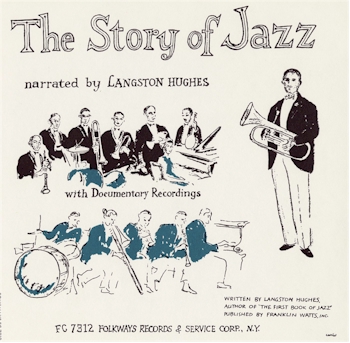
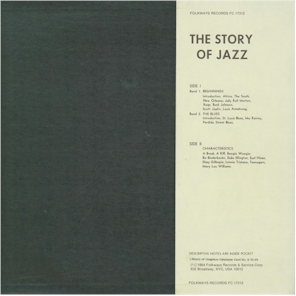
The Story of Jazz (1954)*: |
| "The Story of Jazz" narrated by Langston Hughes, is a concise history of jazz beginning with Drums of the Yoruba, from Nigeria, and continuing to the post-WWII era of be-bop with Dizzy Gillespie's "Oopapada."
| |
|
|
| Beginnings (Introduction, Africa, The South, New Orleans, Jelly Roll Morton, Rags, Bunk Johnson, Scott Joplin, Louis Amstrong) (9:33) |
|
| The Blues (Introduction, St. Louis, Ma Rainey, Perdido Street Blues) (6:53) |
|
| Characteristics (A Break, A Riff, Boogie Woogie, Bix Biederbecke, Duke Ellington, Earl Hines, Dizzy Gillespie, Lenny Tristano, Teenagers, Mary Lou Williams) (15:08) |
|
|
|
|
|
|